
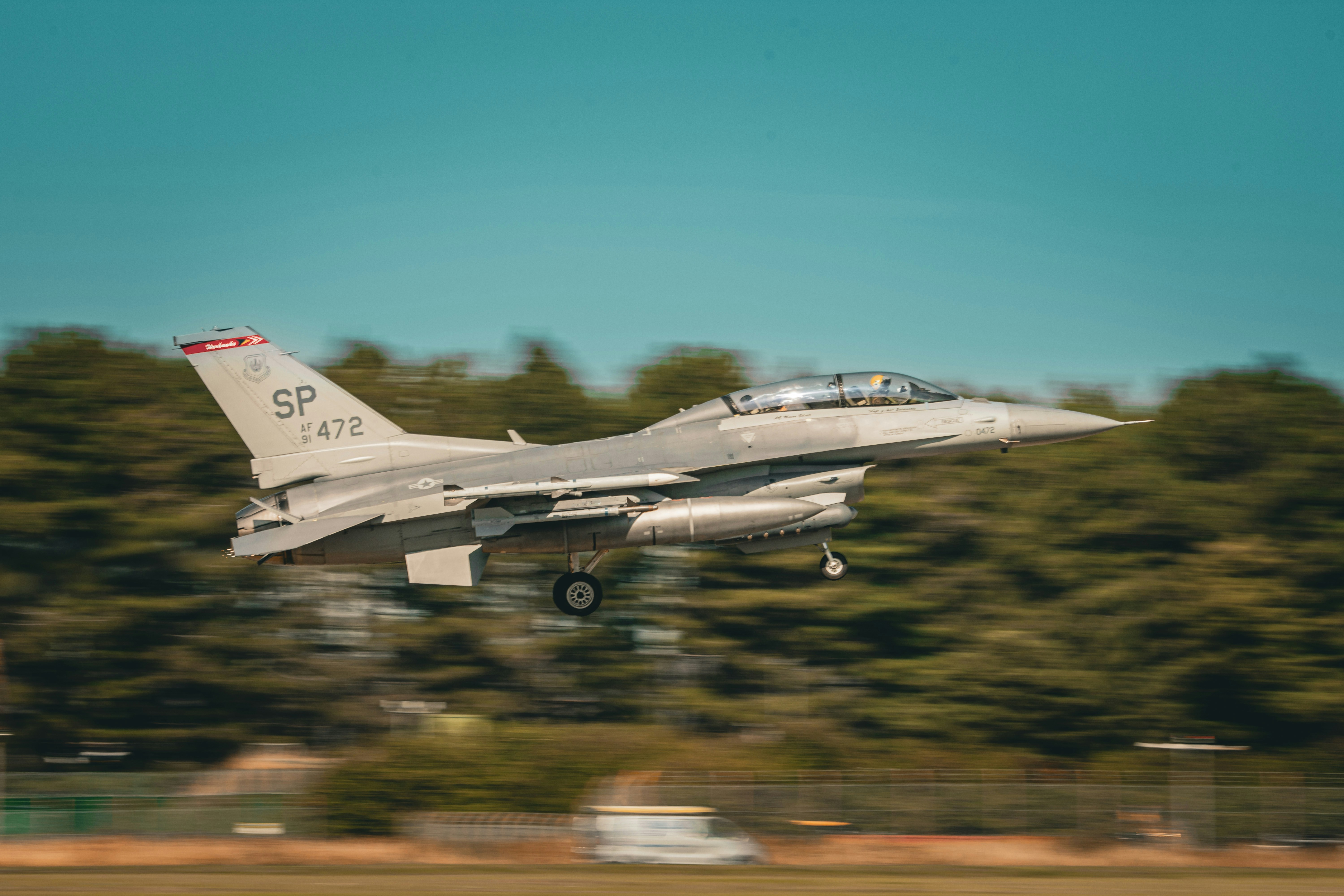
Introduction to the F-16 Fighter Jet
The F-16 Fighting Falcon, developed by General Dynamics and now produced by Lockheed Martin, is a multirole jet fighter known for its remarkable agility and versatility in combat. Initially conceived in the 1970s, the F-16 was designed to provide the United States Air Force with an advanced air combat capability, focusing on achieving air superiority while also being capable of ground attack and reconnaissance missions.
Its development began in response to the changing dynamics of aerial warfare, particularly the need for a more nimble and cost-effective fighter compared to its predecessors. The F-16’s unique design features, such as the frameless bubble canopy for improved visibility, a relaxed static stability design, and an innovative fly-by-wire control system, significantly enhance its operability in various combat scenarios. These attributes contribute to the jet’s exceptional maneuverability and performance, which are essential for modern aerial engagements.
The F-16 was first introduced into service in 1978, marking a significant advancement in fighter jet technology. Over the years, it has been continually updated and modified, leading to several variants tailored for specialized functions, including the F-16C and F-16D models. The fighter jet has been adopted by numerous air forces worldwide, demonstrating its broad appeal and adaptability to different combat requirements.
Throughout its service life, the F-16 has been employed in diverse roles, proving its capability to operate effectively in air-to-air combat as well as ground support missions. With advancements in avionics and weaponry, the F-16’s speed and function have evolved, enabling it to face contemporary threats. As a result, this jet remains one of the most utilized and respected platforms in modern air forces.
Speed and Performance of the F-16
The F-16 Fighting Falcon is renowned for its exceptional speed and performance, making it a prominent choice among modern fighter jets. It boasts a maximum speed of approximately 1,500 miles per hour (2,414 kilometers per hour), allowing it to engage and intercept adversaries swiftly. This remarkable velocity is complemented by its impressive climb rate, which can reach up to 50,000 feet per minute, enabling the F-16 to gain altitude rapidly during aerial engagements.
One of the notable features of the F-16 is its lightweight design, attributed to its single-engine structure and advanced composite materials, which contribute significantly to its agility and maneuverability. A power-to-weight ratio of approximately 1:1 allows the aircraft to perform complex aeronautical maneuvers with ease. Such attributes also enhance its capability in dogfighting scenarios, where quick turns and rapid acceleration can be decisive.
When comparing the speed and performance metrics of the F-16 with other fighter jets in its class, such as the McDonnell Douglas F-15 or the Boeing F/A-18 Hornet, the F-16 demonstrates superior agility. While the F-15 is faster in a straight line, the F-16 is often praised for its operational effectiveness in tight spaces and agility during combat operations. This versatility allows it to adapt to various missions, from air-to-air combat to ground attacks, showcasing its integral role within modern air forces.
Overall, the F-16 jet speed stands as a testament to the aircraft’s engineering excellence and operational versatility, establishing it as one of the leading multi-role fighters in service today.
Air-to-Air Combat Capabilities
The F-16 fighter jet is widely recognized for its superiority in air-to-air combat, largely attributed to its advanced radar systems, versatile weaponry options, and effective engagement tactics. The F-16 is equipped with the AN/APG-68 radar, which provides high-resolution targeting and tracking capabilities, allowing pilots to effectively engage multiple aerial threats simultaneously. This radar system enhances situational awareness during engagements, critical for maintaining an edge in dogfighting scenarios.
In terms of armament, the F-16 boasts a diverse range of weaponry, including the AIM-120 AMRAAM and AIM-9 Sidewinder missiles. The AMRAAM is a beyond-visual-range missile that allows the F-16 to engage enemy aircraft from a distance, utilizing advanced guidance systems to ensure accuracy. Meanwhile, the AIM-9 Sidewinder provides close-range engagement capabilities, essential during tight dogfights where agility is key. The combination of these weapons, along with the jet’s impressive maneuverability, establishes the F-16 as a formidable opponent in aerial confrontations.
Additionally, tactics play a crucial role in the effectiveness of the F-16 in air-to-air combat. Pilots are trained in various dogfighting techniques, which include turning fights, high-speed passes, and ambush tactics. These strategies enable pilots to leverage the aircraft’s speed and agility to outmaneuver adversaries, thus securing air dominance. The F-16’s exceptional climb rate and sustained high speeds further enhance its operational capabilities, enabling pilots to dictate the terms of engagement.
Overall, the combination of advanced radar, a robust selection of weapons, and effective aerial tactics render the F-16 fighter jet a well-rounded and capable platform for achieving air superiority in various operational scenarios.
Air-to-Surface Attack and Versatility
The F-16 fighter jet is renowned not only for its impressive air-to-air capabilities and f16 jet speed but also for its versatility in ground attack missions. This multi-role aircraft excels in executing various combat roles, including precision air-to-surface strikes, which are critical in modern warfare. The F-16 is equipped to deliver advanced precision-guided munitions, allowing it to engage specific targets with remarkable accuracy while minimizing collateral damage.
In the realm of close air support (CAS), the F-16 has proven itself as an indispensable asset. It provides vital support to ground troops by targeting enemy positions and supplying firepower in support of military operations. The aircraft is capable of conducting CAS missions under adverse conditions, enhancing its effectiveness in dynamic combat environments. This adaptability is significant as ground warfare continues to evolve, often requiring rapid response and precision targeting.
Throughout its service history, the F-16 has been involved in numerous successful missions that highlight its ability to support ground forces. For example, during Operation Desert Storm, the F-16 played a pivotal role in striking hardened enemy positions and infrastructure, showcasing its capability to deliver fast and accurate strikes at optimal f16 jet speed. Another noteworthy instance occurred in more recent conflicts, where F-16s delivered precision strikes against high-value targets, demonstrating their seamless integration of speed and function as a ground attack platform.
Overall, the F-16’s wide array of functions—including aerial combat and ground attack—affirms its status as a stalwart of air power. Its agility and advanced munitions capability ensure that the F-16 remains an effective tool for addressing diverse mission requirements in the ever-changing landscape of conflict.